Planning through burnout, when the list is the problem.
There’s a point where the to-do list stops being a tool and becomes the thing you can’t face. Dune Seven is built to be usable on exactly those days.
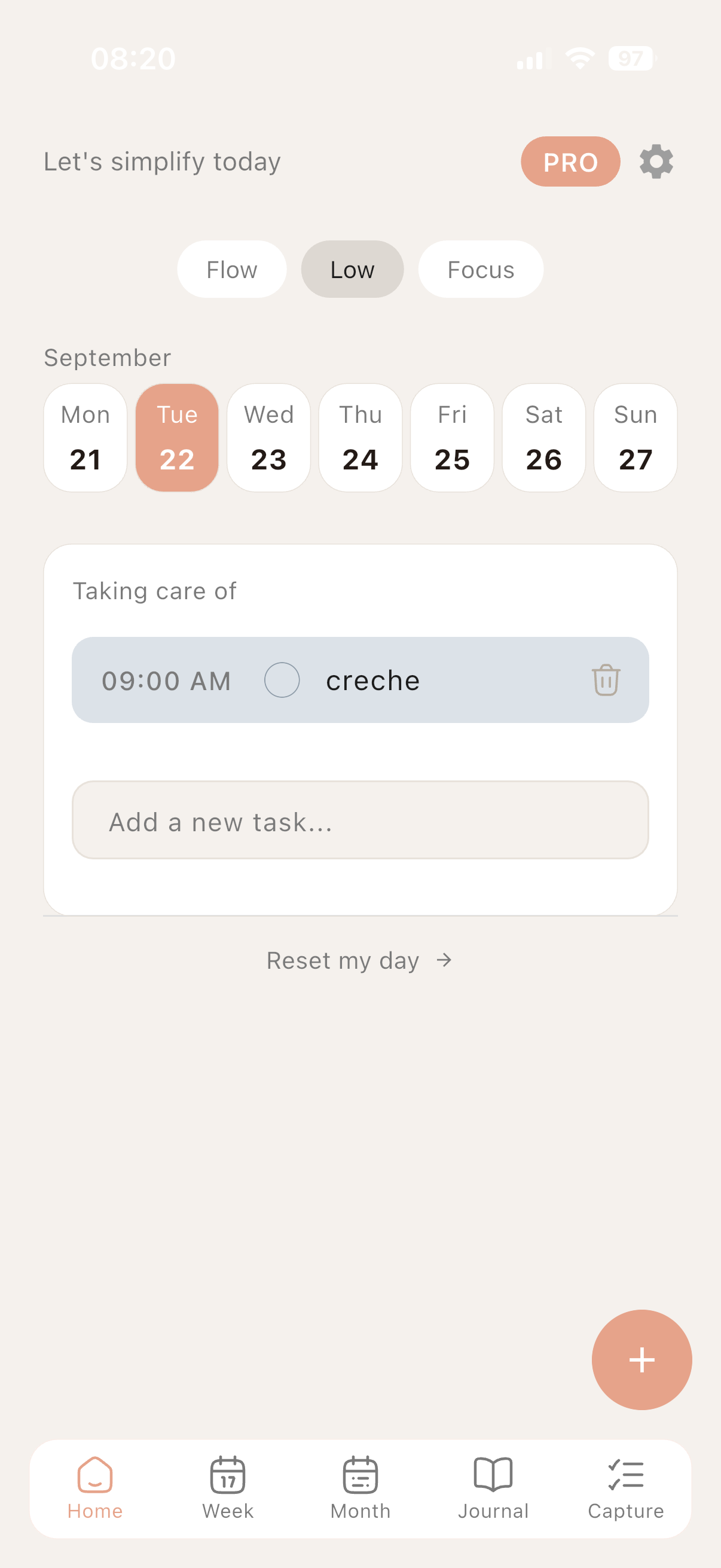
Low mode. The app gets smaller when you do.
Switch to Low and the home screen contracts. Less on screen, fewer decisions, less to face. Nothing is deleted; the surface you have to meet shrinks to something survivable.
Read on
Burnout narrows capacity in every direction: energy, decision-making, tolerance for stimulus. A standard planner answers that narrowing with the same wall of tasks it always did, in the same density, with a streak counter attached. Opening the app becomes its own aversive event. That isn’t a discipline failure. It’s a design mismatch.
When capacity returns, Flow opens back up. Focus narrows the world to one thing when that’s what’s needed. You move between them freely, as many times a day as reality demands.
Reset my day.
Some days need to start over at 2pm. One tap clears the slate, with no summary of everything you didn’t manage and no encouragement to try harder.
Read on
Habit tracking has no cap and no penalty. A missed week is a missed week, not a broken chain and not a red mark. Daily priorities cap at three by design; naming one and leaving two blank is a legitimate use of the app. Plan for the energy you actually have, not the energy you used to have. That distinction is the entire product.
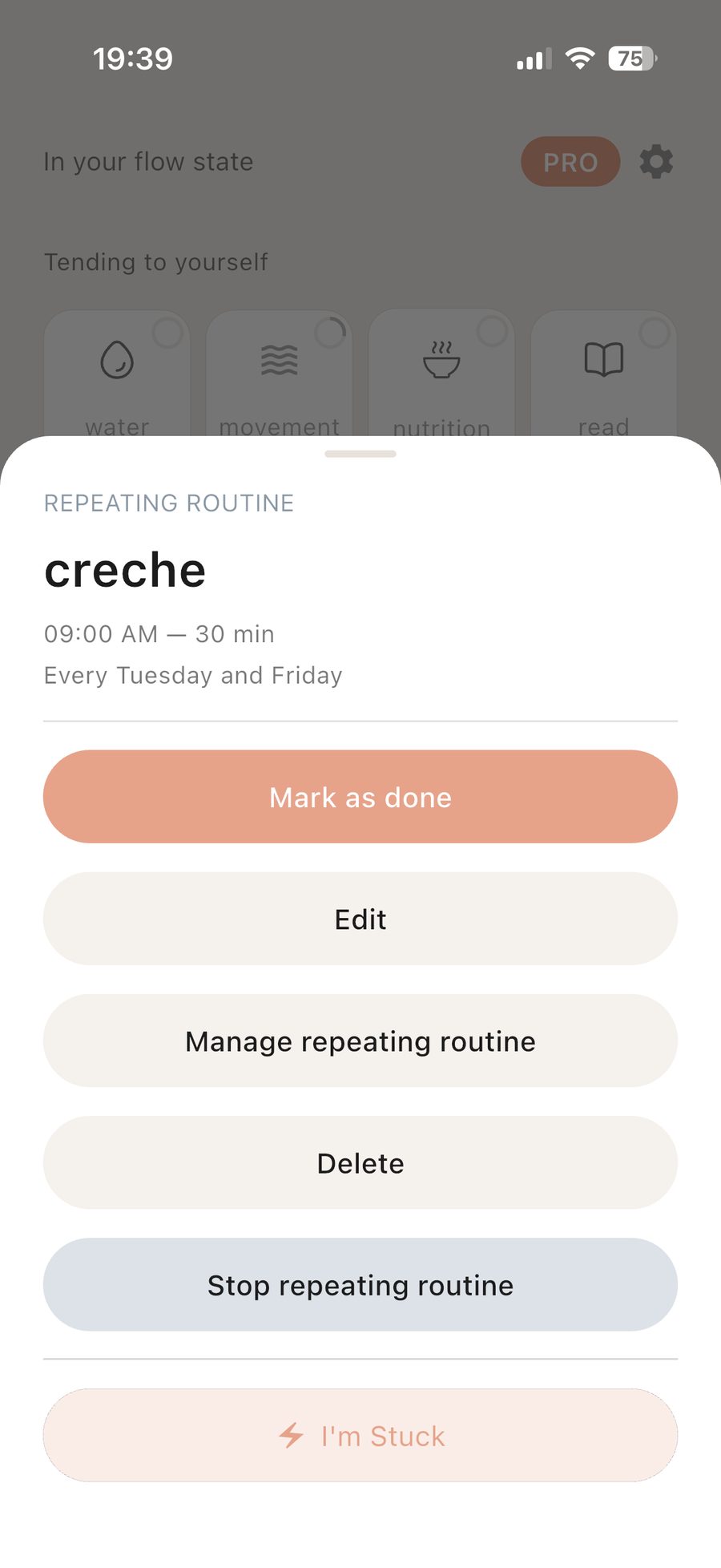
When a task becomes a wall.
Tap I’m Stuck and it becomes three to five steps you can actually start. Useful on the days when starting is the whole problem.
Read on
It never judges the task or the delay. It breaks it down and hands you the first step. The Journal is there too, private and quiet, for what’s heavy but isn’t a task.
What this is, and isn’t.
Dune Seven is a planner. It isn’t therapy, medical treatment or a substitute for either.
Read on
Burnout that involves persistent low mood, hopelessness or difficulty functioning is worth taking to a GP or a mental health professional. A planner is a support alongside that, not instead of it. What it can do is stop your organising system from being one more thing making the days harder.
Burnout and overwhelm questions.
I’ve abandoned every planner I’ve tried. Why would this be different?
Because the failure point is usually the same: the app expects the same output from you on your worst day as your best. Low mode is a direct answer to that. The app shrinks to match your capacity instead of holding a fixed standard you have to keep meeting.
Will it make me feel guilty for missing days?
No. There’s no streak punishment, no red marks, no summary of what you didn’t do, and no notifications designed to shame you back into the app.
Is this a mental health app?
No. Dune Seven is a daily planner. It doesn’t diagnose, treat or replace professional care. If burnout is affecting your ability to function, please talk to a GP or a mental health professional.
Can I use it just for a few things?
Yes. Naming one priority and leaving the rest empty is a completely valid way to use it. There is no minimum.
★★★★★
“Finally I’ve found an app that is free but also targets exactly how my brain functions.”
App Store review, September 2026
Also read.
- ADHD and executive dysfunctionPlanning paralysis, time blindness, task initiation. Designed around them, not in spite of them.
- Mental loadYou’re already running the household in your head. This reduces what you have to hold.
- PostpartumBuilt out of a real postpartum experience. Plan for where you actually are.
- Shift work and rostersYour week doesn’t start on Monday. Built by shift workers, so it doesn’t here either.
A planner you can still open on a bad day.
Free, forever. Switch to Low and let the app get smaller with you.