You know your energy. We just plan around it.
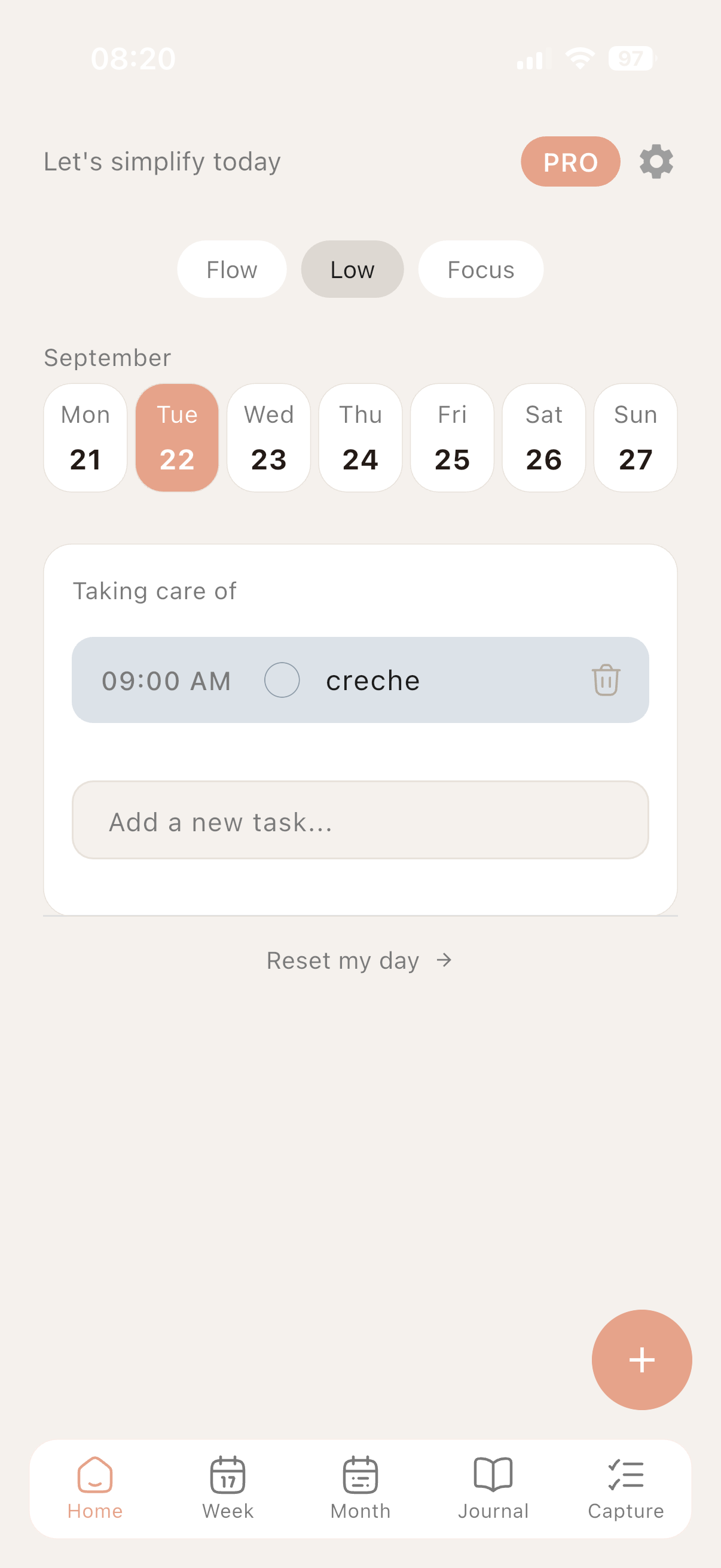
The energy-based planner with no wearable required. You choose Flow, Low or Focus, and the plan bends around it. No sensors, no algorithm, no guilt.
Nobody needs a sensor to tell them they’re exhausted.
There is a new promise in planning apps: we’ll read your energy and plan your day for you. We think it gets one thing right and everything else wrong.
Read on
Here is how that promise works. You buy a wearable. You give an app your heart rate, your sleep, your movement. An algorithm decides how much energy you have. Then it rearranges your day, whether you agree with it or not.
Energy-first planning is correct. Your capacity is not the same at 7am as at 3pm, or the day after a night shift as after nine hours of sleep. Any planner that treats every hour as identical is lying to you, and you feel that lie as guilt. We built Dune Seven on that truth in 2019, back when it was a paper planner and energy-based planning wasn’t a category yet.
The part they got wrong.
You do not need a sensor to know how you feel. You knew the moment you woke up. So we do something radical. We ask you.
Read on
If you live with ADHD, you know something the sensors don’t: your energy doesn’t always follow your sleep score. You can sleep nine hours and wake foggy. You can sleep five and hit a hyperfocus streak that moves mountains. A wearable reading your heart rate cannot see that. You can.
You choose your energy. The plan bends around it. That’s the entire mechanism, and it changes whose day it is.
In black and white.
- No extra equipmentYour planner should not require a $400 device on your wrist before it works. Dune Seven works with your phone and your self-knowledge.
- No biometric data leaving your phoneWe never see your heart rate, your sleep or your movement, because we never ask for it. Nothing to harvest, nothing to leak, nothing to sell.
- No algorithm overriding youThe moment an app decides what your energy is, it has decided it knows you better than you do. We refuse that premise. An app that tells you your energy is just guilt with sensors.
- Your self-knowledge, taken seriouslyChoosing your energy is a thirty-second act of honesty each day. Over weeks it becomes proof that you can read yourself, trust yourself, and plan like it.
The number didn’t describe your day. It wrote it.
Your watch says your readiness is 42%. So you brace for a bad day, lower your effort before you’ve tested it, and by evening the prediction has come true.
Read on
Not because the sensor was right, but because you believed it before you believed yourself. You are a human, whole and holistic, not a heart rate and a sleep score. Your energy is shaped by things no sensor will ever see: what’s on your mind, who you love, what you’re carrying, what you’re hoping for. No one knows you but you.
A human-driven planner, on purpose.
Dune Seven uses AI in exactly one place: when a task feels too big to start, I’m Stuck breaks it into smaller steps. Nothing else.
Read on
It doesn’t read your calendar, doesn’t schedule your day, and doesn’t quietly learn your patterns to decide things for you. That boundary isn’t a limitation waiting to be lifted. It’s the whole point. This is for the shift worker whose morning starts at 6pm, the parent running on broken sleep, the ADHD brain whose energy arrives in waves no sensor can chart. You are the only person who has ever been inside your body. Your planner should act like it.
★★★★★
“Finally I’ve found an app that is free but also targets exactly how my brain functions.”
App Store review, September 2026
Five ways in.
- ADHD and executive dysfunctionPlanning paralysis, time blindness, task initiation. Designed around them, not in spite of them.
- Mental loadYou’re already running the household in your head. This reduces what you have to hold.
- Burnout and overwhelmFor when the to-do list itself has become the thing you can’t face.
- PostpartumBuilt out of a real postpartum experience. Plan for where you actually are.
- Shift work and rostersYour week doesn’t start on Monday. Built by shift workers, so it doesn’t here either.