Postpartum, with a brain that isn’t quite yours yet.
Broken sleep, fog, and a mental load that doubled overnight. Dune Seven was built by a mother in exactly this stage, for exactly this stage.
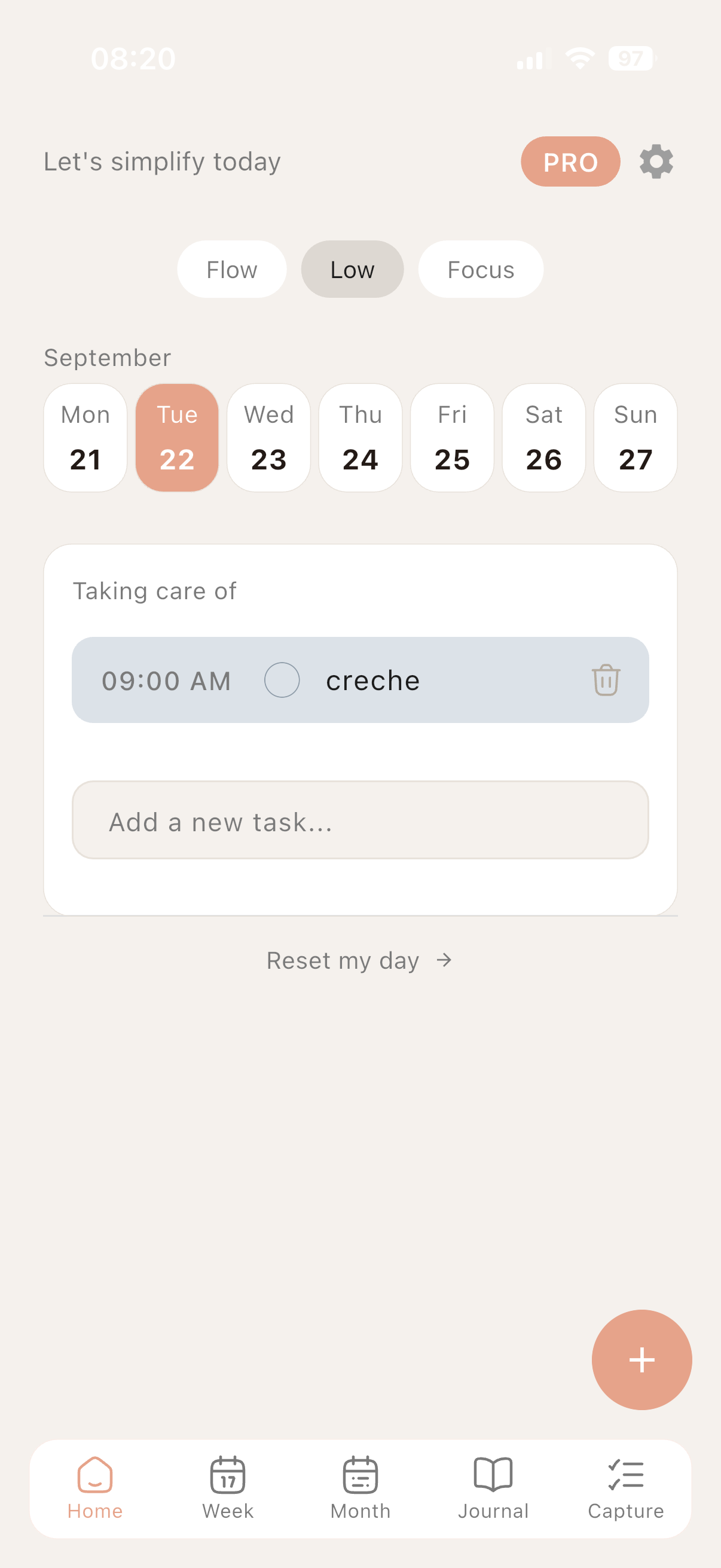
Low mode, for most days at first.
Switch to Low and the home screen contracts to something you can meet on four hours of broken sleep. Nothing is deleted. You’re just not asked to face all of it at once.
Read on
Postpartum cognitive change is well documented: fragmented sleep, hormonal shift and relentless vigilance affect working memory, word-finding and the ability to hold a sequence of steps in your head. You put the phone in the fridge. You lose the thread mid-sentence.
Then you open a planner still calibrated to who you were eighteen months ago, and it quietly tells you you’ve gone backwards. On the days the fog lifts, Flow is right there.
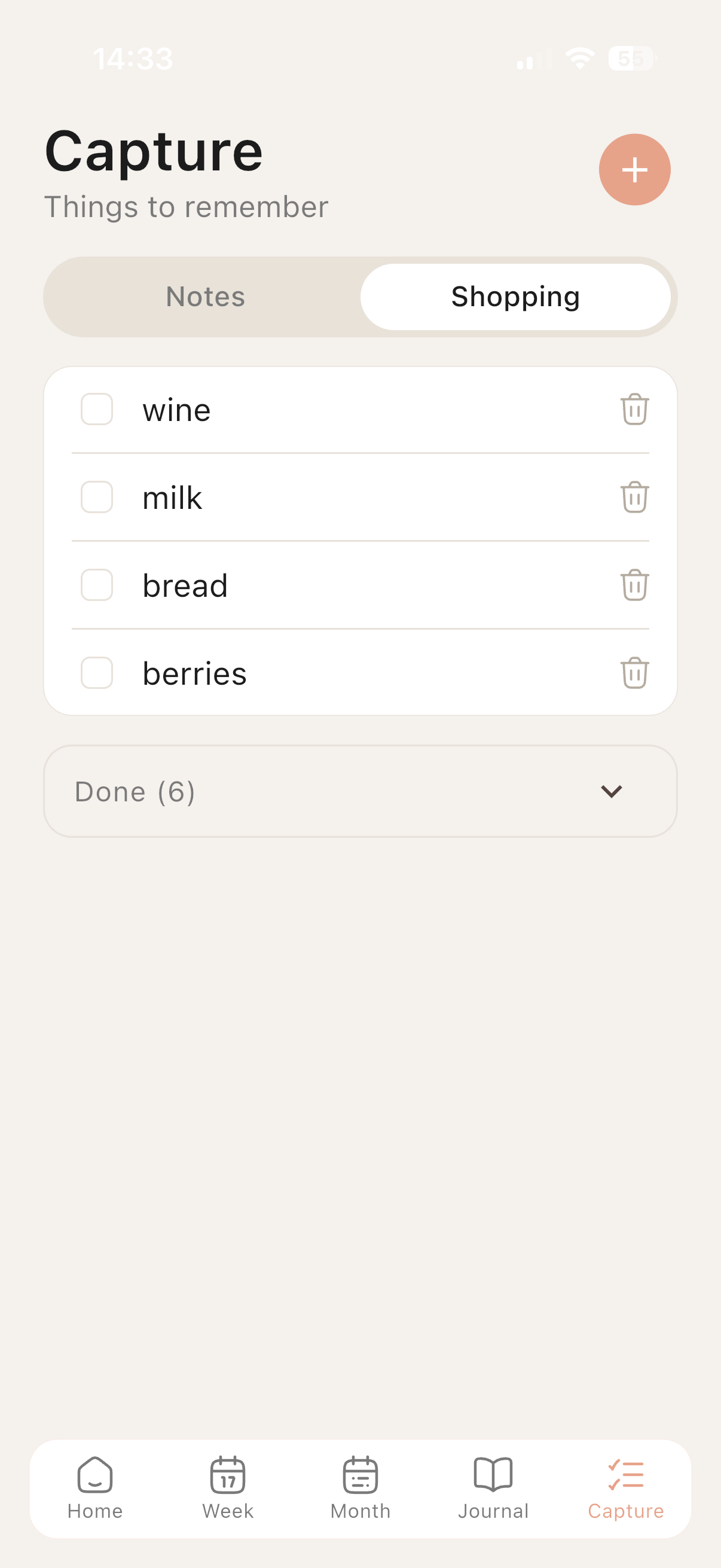
Capture, because you will not remember.
The health nurse appointment, the thing your mother said, the nappy size you’ve outgrown. Two taps and it’s out of a working memory that currently has no room.
Read on
Shopping on one tab, notes on the other, the Journal for the rest. This is the single feature postpartum users use most.
Three priorities, and a shower counts.
What matters most today caps at three. In the fourth trimester, “eat something” and “get outside” are entirely legitimate entries. There’s no category police and no productivity score.
Read on
Water, movement, nutrition and read: track them if it helps, ignore them if it doesn’t. No streak punishment, no cap, no broken chain to feel bad about during a growth spurt. Repeating routines hold the appointments and rhythms that recur, so you don’t have to.
A new baby doesn’t add tasks so much as continuous background monitoring: feeds, wake windows, appointments, milestones, and the household that still exists underneath all of it. If you were already the default rememberer, you now hold two full indexes at once. That’s mental load, and it’s what most postpartum exhaustion is made of.
If it’s more than tiredness.
Postpartum depression and anxiety are common and treatable, and they’re not the same as fog or exhaustion.
Read on
If you’re struggling with persistent low mood, intrusive thoughts or anxiety, please speak to your GP or maternal health nurse, or contact PANDA on 1300 726 306 in Australia. A planner sits alongside that support, never in place of it.
Postpartum planner questions.
Is this a baby tracker?
No. Dune Seven doesn’t track feeds, sleep or nappies. It’s a planner for you: your day, your priorities, your mental load. Plenty of people run a baby tracker alongside it.
I can barely use my phone one-handed. Is it simple enough?
That was a real design constraint. Capture takes two taps, priorities cap at three, and Low mode strips the home screen down to the minimum. There’s nothing to configure before you can use it.
Is baby brain actually real?
Postpartum cognitive change is well documented and driven by fragmented sleep, hormonal shift and sustained vigilance. It affects working memory and word-finding. It’s real, it’s common, and it isn’t a permanent state.
Does it cost anything?
There’s a permanently free tier with no card required. Pro is A$69.99 a year or A$12.99 a month. Lifetime is a single payment of A$129.99.
Who built it?
Angela Kocek, an emergency services worker and a mother, out of her own postpartum experience and years of coaching women through overwhelm and mental load.
★★★★★
“Finally I’ve found an app that is free but also targets exactly how my brain functions.”
App Store review, September 2026
Also read.
- ADHD and executive dysfunctionPlanning paralysis, time blindness, task initiation. Designed around them, not in spite of them.
- Mental loadYou’re already running the household in your head. This reduces what you have to hold.
- Burnout and overwhelmFor when the to-do list itself has become the thing you can’t face.
- Shift work and rostersYour week doesn’t start on Monday. Built by shift workers, so it doesn’t here either.